

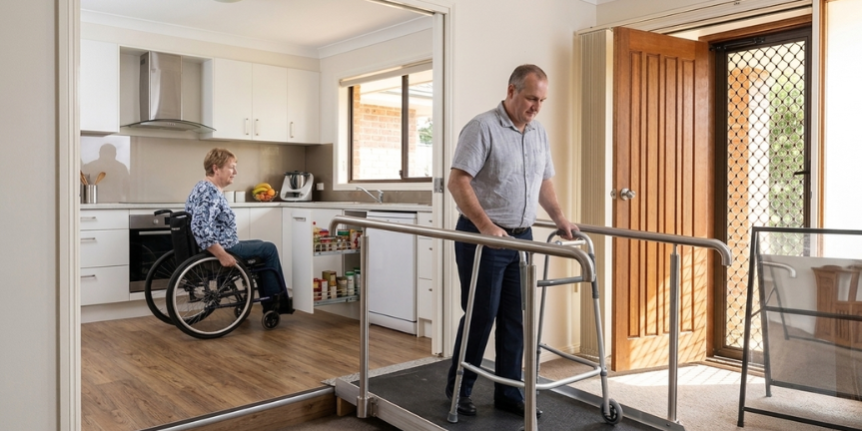
You or a family member with an NDIS plan may already know that funding can cover modifications to the home. What is less widely understood is the range of what qualifies.
NDIS home modifications in Perth can go well beyond grab rails, handrails, and ramps. A residential or platform lift can be a legitimate and fundable solution for people with mobility limitations that affect their ability to move between levels of their home, provided the right conditions are met.
The questions we get most often from participants and families are practical: does my plan cover this, what does the approval process actually involve, and how long does it take to get from a funded plan to an installed lift? The process has more steps than most people expect, and the pathway is not always clearly explained by planners or Local Area Coordinators.
Alto Lift is based in Joondanna, and we supply and install platform lifts across the Perth metro area. We are not a registered NDIS provider but work regularly with participants, support coordinators, and occupational therapists navigating the home modifications pathway. We understand what documentation the NDIS requires, what a compliant quote needs to include, and what the building approval process looks like for a lift installation in a Perth home.
How NDIS Funding for a Residential Lift Actually Works
Funding for NDIS includes the following budget categories. For a home or platform lift, the most relevant is Capital Supports, categorised by Assistive Technology and Home Modifications.
Financing Categories: Home Modifications Permanent platform lifts are generally funded in the Home Modifications category. It encompasses alterations to a home that fulfill an individual’s functional need related to disability, which could be structural or non-structural.
For example, if this need is established as a clear requirement in the OT report, a vertical platform lift for wheelchair usage and a standing platform lift for split-level access can be implemented.
Assistive Technology stands in a separate category and, by that generalisation, includes equipment that is used to assist a person with the activities of daily living with no alterations involved in the building.
Some modular, low-rise lifts are more portable and could be eligible for AT funding if they are more portable and require little to no building work. That difference is important because AT and Home Modifications belong in their own piece of equipment, and they can’t be transferred between them.
One of the first things that an NDIS planner or Local Area Coordinator (LAC) will look at is Capital Supports as part of the current plan. Home Modifications funding is not automatic. This is typically set at a plan review or planning meeting, after the participant provides evidence from an Occupational Therapist. Important to point out, the NDIS sets a very clear distinction between minor and complex home modifications.
Smaller changes, generally less than $10,000, can be agreed upon in a less extensive evidence procedure. Most of the platform lift installations will be very complex modifications that will also be included, they would need more detailed documentation, a formal OT report and quote from a registered building practitioner. It would be easier to steer clear of delays after the fact if you knew which category would work for you at the outset.
The Role of the Occupational Therapist and Why Their Report Makes or Breaks the Application
The OT assessment is the key evidence linking a lift to a participant’s disability-related need, as well as the rationale that a lift is the best home solution. For any home modifications greater than $20,000, a complete Home Modification Report with relevant OT documentation must be completed.
Many platform lift installations exceed this benchmark once all builder work, permits, and compliance costs are included, and are therefore treated as a complex home modification.
Complex works will typically require an OT report, a comprehensive quote from a registered building practitioner, and NDIS approval prior to work commencing.
The OT report will typically include:
- The functional impact of the disability.
- The access problem in the home and associated safety risks.
- What access solutions were considered, and why a lift is the most appropriate option.
- What makes it fall within reasonable and necessary criteria, specifically that it is disability-related and represents value for money.
With significant experience in complex home modifications as the target, a qualified OT will be best positioned to frame functional need and value for money in language the NDIS uses to lower the odds that further information will be sought or delays can arise.
Selecting an OT who has previously worked on platform lift installations should be a priority. They will have an understanding of the technical language surrounding compliance standards, know what a planner is looking for, and will be able to present a lift as the most reasonable solution in cases where alternatives such as ramps or stairlifts may not be suitable to the property or the participant’s needs. With the right experience your support coordinator can recommend an OT in Perth.
What We Supply and Install: Platform Lifts That Meet the Requirements
Alto Lift specialises in compact platform lifts suited to both residential and small commercial properties where a full-shaft passenger lift would be structurally impractical or cost-prohibitive.
For NDIS and building approval purposes, the most important technical information is that Alto Lift’s vertical platform lifts are certified to EN 81-41, the European standard for platform lifts for persons with reduced mobility, and are installed in Australia in compliance with the National Construction Code (NCC) and AS 1735.15, which governs vertical platform lift installations for people with disabilities. That compliance documentation is what a WA building permit requires and what an NDIS planner needs to see before approving the modification.
In practice, these units don’t require a lift pit or a raised overhead shaft, meaning there’s minimal structural interference in a standard house. With minimal modification, the modular system integrates nicely into the existing structure and easily fits standard wheelchair widths on the platform. These controls facilitate independent use, a practice that complements the NDIS principle of supporting participant independence.
Where a customer needs increased travel height, a larger weight capacity, or full weather enclosure, a residential lift may be a better fit. Reach out to us to discuss which works best for your home and access needs.
Perth Properties and Why the Local Context Matters
Not every Perth property suits the same lift solution. Floor plan, lot gradient, soil type, climate exposure and construction scope all play a role in finding the right product and in determining what NDIS funding applies.
Split-level houses are common in older suburbs such as Nedlands, Subiaco and Mount Lawley where higher footings and tiered interior layouts make it difficult for them to access. A vertical platform lift on an exterior or semi-external landing also works to resolve the same access problem with little to no interior disturbance and without the footprint that a long internal ramp would require.
Lift pit excavation is expensive and variable in Perth, which is characterised mostly by sandy soils and limestone substrata where a major impact on the foundation often occurs on unexpected grounds. But in place of pit-free platform lifts then, which you quote about is avoided, it also minimises the scope of the work! Such simplicity is a plus, at a time when the NDIS is considering value for money.
Any outdoor lift installation needs to be adapted for the UV and summer weather in Perth too. Alto Lift platforms come with a powder-coated steel and are UV-resistant, making them a perfect match for Perth’s climate – almost all of such installations do not require an additional protective enclosure.
For installations in exposed coastal locations (Cottesloe, Scarborough or Rockingham), we look at finish and material specifications on our site visit for longevity. Where structural work includes floor openings, new landings or external structures, all building permits and licences are under our control as registered building practitioners who provide the NDIS planning documentation for the requirements for compliance from their NDIS planner.
A site assessment specific to Perth, you’ll know what is structurally feasible and what approvals are required, what documentation you’ll need to meet in order for it to be approved through the NDIS.
Common Questions About NDIS Lift Funding in WA
Below are the questions we most commonly receive from participants, families, and support coordinators about funding a residential or platform lift through an NDIS plan in Western Australia.
1. Does every NDIS participant qualify for Home Modifications funding?
No. Home Modifications is a Capital Supports line item that must be included directly in a participant’s plan. It is not automatic. It is determined by the evidence provided at either the planning stage or a plan review, with the OT report being the primary document.
If your current plan does not include Home Modifications, the pathway is to request a plan review and provide updated supporting evidence from your OT. A support coordinator can assist in preparing for this review and ensuring the evidence is presented clearly.
2. Can an NDIS-funded platform lift be installed in a rental property?
Funding modifications to a rental property is possible in some circumstances, but the process involves additional requirements. The OT will need to demonstrate in their report that the modification is structurally feasible, and written consent from the property owner must be obtained before the application proceeds.
The landlord must agree to the modification, and in most instances the lease will need to address what happens to the installation at the end of the tenancy, whether it is removed, remains in place, or is transferred. This is a conversation worth having with your support coordinator early, as obtaining consent and resolving tenancy arrangements can add time to an already lengthy process.
3. What does a quote need to include to support NDIS approval?
For a complex Home Modification, the NDIS requires a quote from a registered building practitioner that clearly describes the scope of work in a way that allows a planner to assess value for money.
Our quotes cover the product being supplied, the installation method, any associated builder work including platform construction, structural openings, and electrical connection, as well as all compliance and permit costs. We provide this documentation routinely to support approval without delays. If an OT or support coordinator needs us to include specific line items or reference particular compliance standards, we are happy to accommodate that.
4. Does the NDIS cover ongoing maintenance?
The initial installation is funded through Capital Supports. Ongoing servicing and maintenance is a separate matter. It may be eligible for funding through the Assistive Technology Maintenance and Repair line item in a participant’s plan, depending on how the lift was categorised in the original approval.
We offer ongoing lift maintenance and servicing across the Perth metro area. For NDIS participants, we can provide maintenance schedules and service records that support future plan reviews and demonstrate that the equipment is being appropriately maintained.
5. Are WA building permit requirements factored into the quote?
Yes, and we address them upfront. Our guide to WA building codes for home elevator installation covers the permit requirements that apply to residential lift installations in Western Australia.
Building approval is not optional for a permanently installed platform lift. The permit documentation forms part of the compliance record that the NDIS expects to see before funds are released. Attempting to install a lift without the appropriate permit would also create complications at the NDIS approval stage, so it is always addressed as part of the initial scope of works.
Getting Started With Your NDIS Platform Lift in Perth
NDIS lift funding takes time. OT evidence, NDIS approval, permits, and installation all require thorough coordination across multiple stages. Done well, the result is a funded lift that meaningfully improves safety and independence at home, reducing reliance on carers for transfers, giving participants greater freedom of movement within their own property, and future-proofing the home against changing access needs.
Alto Lift serves the Perth metro area. If your NDIS plan includes Capital Supports and you would like to understand what a platform lift might look like in your home, call 0416 199 267 or contact us to book a no-obligation site assessment. We can provide the detailed quote your OT and planner need.